
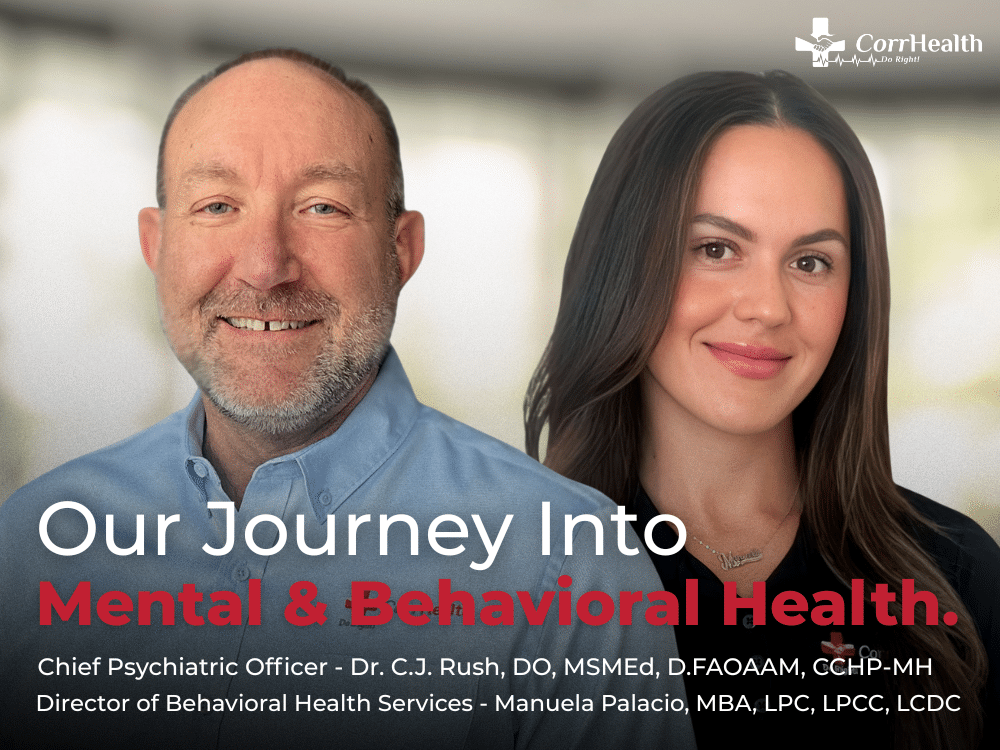
Mental Health Awareness Month is an opportunity to recognize not only the importance of mental and behavioral health care, but also the professionals who dedicate their lives to supporting others through some of life’s most difficult moments.
At CorrHealth, that commitment is reflected every day through the work of leaders like Chief Psychiatric Officer Dr. C.J. Rush and Director of Behavioral Health Services Manuela Palacio. Although their paths into the field were different, both were driven by a deep curiosity about human behavior, a passion for helping underserved populations, and a belief that mental health care has the power to change lives.
In this article, Dr. Rush and Manuela share their personal journeys into Mental Health and Behavioral Health, the experiences that shaped them, and the perspectives that continue to guide their work today.
Finding Purpose Through Understanding People
For Dr. Rush, the journey into Mental Health began with a fascination for the human brain and behavior. While earning his undergraduate degree in psychology, he became deeply interested in how the brain influences decision-making and human behavior. That interest followed him into medical school, where a psychiatry rotation during his third year sparked something greater.
“My undergraduate degree is in psychology. I’m fascinated by the brain and how it creates behavioral choices,” Dr. Rush explained. “When I was in medical school, my rotation in psychiatry led to more rotations, and then ultimately a psychiatry residency.”
At one point, Dr. Rush found himself deciding between psychiatry and neurology. However, after spending three straight days on stroke call during a Christmas holiday weekend, the answer became clear.
“That cemented my decision for psychiatry,” he said.
For Manuela, the path into Behavioral Health was less direct, but equally meaningful. Originally, she envisioned a career in law. Over time, however, her experiences and exposure to different environments led her toward a deeper interest in emotional functioning, human behavior, and the complexity of the mind.
“What began as curiosity gradually developed into a genuine passion for understanding people on a deeper level and supporting them through difficult experiences,” Manuela shared. “Over time, I realized that mental health work combined critical thinking, human connection, and advocacy in a way that felt both meaningful and purposeful to me.”
The Moments That Confirmed Their Calling
Both Dr. Rush and Manuela can point to specific moments in their careers that confirmed they were exactly where they were meant to be.
For Manuela, it was a brief but unforgettable interaction with a former patient she had worked with in a hospital detox unit.
“While walking around a park, I saw one of the patients I had worked with,” she recalled. “They thanked me for talking them out of leaving against medical advice because, if not, they wouldn’t be alive. It made me believe this work is worth it.”
Dr. Rush shared a powerful experience from his residency while working on an inpatient child psychiatric unit. A 15-year-old Amish girl had been admitted in a severe psychotic and catatonic state. After several days and court approval for treatment, the care team began administering medication.
Around the ninth day, everything changed.
“She became embarrassed by her nudity, asked for her Amish clothing, started eating and drinking again, and asked for her Bible,” Dr. Rush said. “That was the day I realized psychiatry works and I learned the true importance of the field.”
For both leaders, these moments reinforced the same truth: Mental Health and Behavioral Health care can profoundly change lives.
Reducing Stigma and Changing Perspectives
When discussing Mental Health awareness, both Dr. Rush and Manuela emphasized the importance of reducing stigma and helping people better understand serious mental illness.
“For me, mental health awareness campaigns are one of the best tools we have to fight stigma,” Dr. Rush explained. “The awareness should focus on acceptance of serious mental illness as a medical condition of the brain’s failure to work as it is designed.”
He also stressed that psychiatric symptoms are not simply behavioral choices.
“Psychiatric patients don’t exhibit behaviors by choice,” he said. “Their symptoms come from a failure of the brain to operate at its full potential. Unfortunately, many people still just see them as ‘crazy’ or ‘weird.’”
Manuela echoed similar thoughts while emphasizing the importance of emotional well-being as part of overall health.
“To me, mental health awareness means recognizing that psychological and emotional well-being are fundamental components of overall health,” she shared. “Mental stability and emotional resilience are just as important as physical health.”
At the same time, both acknowledged the importance of personal responsibility and proactive care.
“Our brain is our responsibility,” Manuela said. “Caring for it means being aware of mental health and seeking support when needed.”
Mental Health in Correctional Settings
Working in correctional healthcare has also shaped how both Dr. Rush and Manuela view Mental Health and Behavioral Health treatment.
Dr. Rush described correctional populations as some of the most underserved patients in healthcare.
“This population is the most underserved, yet the most deserving of appropriate healthcare,” he explained. “Even more so in corrections, many struggle to advocate for themselves because of the very nature of their illness.”
Manuela emphasized that incarceration does not remove someone’s humanity or their need for care and support.
“I wish more people understood that incarceration does not erase someone’s need for physical and mental healthcare, stability, and support,” she said. “What we often see on the surface, anger, withdrawal, aggression, or shutdowns, is frequently rooted in trauma, chronic stress, fear, or untreated conditions.”
She also stressed that treatment and accountability can coexist.
“A therapeutic approach is not about making excuses for behavior,” Manuela explained. “It is about helping people develop insight, emotional regulation, accountability, coping skills, and healthier ways of responding to stress.”
Growth Through Experience
Throughout their careers, both Dr. Rush and Manuela said their perspectives on Mental Health have continued to evolve.
For Dr. Rush, that evolution has become increasingly grounded in biology and neuroscience.
“My perspective has become more biology and neuroscience based,” he explained. “Serious mental illness should be understood as a medical condition.”
Manuela shared that her work has taught her to move beyond black-and-white thinking.
“Working in this field quickly teaches you that people are complicated,” she said. “Behind every situation, there’s usually a story, a need, or something deeper going on.”
She added that this understanding has made her more patient, compassionate, and thoughtful in her approach to care.
Caring for Themselves While Caring for Others
Supporting others in Mental Health and Behavioral Health settings can be emotionally demanding, making self-care an important part of long-term sustainability.
Dr. Rush approaches life with what he describes as radical acceptance.
“I stay rational and accepting of the chaos of the universe,” he said. “I surround myself with positive people, lean into my family, and embrace discomfort because nothing changes when you are comfortable. Oh, and golf.”
Manuela’s approach includes grounding herself through hobbies, physical activity, and stepping away from constant negativity.
“I like to go outside and touch grass,” she said. “Not enough people do it.”
She also shared her love for bodybuilding, nutrition, volleyball, self-help books, fantasy, spending time with her dogs, and even the importance of a good manicure and pedicure.
Both perspectives highlight an important truth in Mental Health and Behavioral Health work: caring for others begins with learning how to care for yourself.
Advice, Perspective, and Purpose
As the conversation came to a close, both Dr. Rush and Manuela shared reflections that speak to resilience, growth, and vulnerability.
Dr. Rush described himself as “non-traditional” in his path to medicine. After serving 12 years in the U.S. Army as a medic, he decided to pursue higher education and eventually medical school at age 38.
“We are never too old and it is never too late to start your path,” he said. “We may feel it is too late, but that is simply a lie we tell ourselves to stay on the comfortable couch of life. Seek discomfort deliberately. Get off the couch.”
Manuela emphasized the courage it takes for individuals to seek help and speak openly about their struggles.
“Going to therapy and talking about our lived experiences and trauma is not weakness,” she said. “It requires courage and vulnerability. More people should tap into that. Our world would certainly be better.”
A Shared Commitment to Mental & Behavioral Health
Although their journeys into Mental Health and Behavioral Health began differently, Dr. Rush and Manuela share a common purpose: helping people heal, grow, and regain stability during some of the most difficult moments of their lives.
Their stories serve as a reminder that Mental Health care is not only clinical. It is deeply human. It requires compassion, understanding, accountability, and a willingness to see people beyond their circumstances.
This Mental Health Awareness Month, CorrHealth is proud to recognize leaders like Dr. Rush and Manuela, whose passion, experience, and dedication continue to make a meaningful difference every day.
Chief Psychiatric Officer – Dr. C.J. Rush, DO, MSMEd, D.FAOAAM, CCHP-MH
Director of Behavioral Health Services – Manuela Palacio, MBA, LPC, LPCC, LCDC