
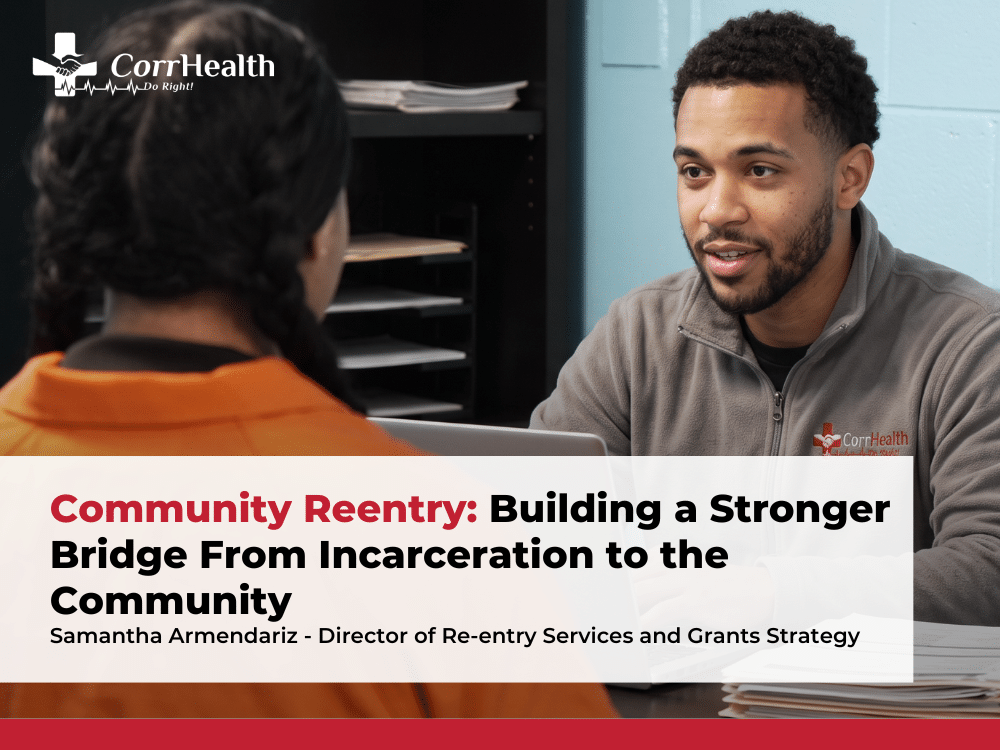
For someone leaving incarceration, release is not simply the end of time spent in custody. It is the beginning of one of the most vulnerable and complicated transitions they may ever face.
In a matter of hours, an individual can go from a highly structured environment to being responsible for securing housing, transportation, medication, treatment, employment, identification, benefits, court compliance, and family responsibilities. Many are expected to manage all of these needs at once, often with limited resources and little room for error.
For Samantha Armendariz, Director of Re-Entry Services and Grants Strategy at CorrHealth, this reality is why community reentry must be viewed as much more than a referral or a resource packet.
“Reentry is a process that requires planning, coordination, communication, and follow-through,” Samantha explains. “Expecting someone to navigate all of that alone is not realistic.”
Successful reentry requires communities to build a bridge between incarceration and life after release. That bridge depends on continuity of healthcare, practical support, meaningful collaboration, accountability, and a willingness to recognize that no single organization can meet every need on its own.
Why Community Reentry Matters
The importance of community reentry extends far beyond the individual leaving custody.
People return to families, neighborhoods, workplaces, healthcare systems, courts, and communities. Samantha notes that the vast majority of incarcerated individuals will eventually return to the community, which makes the transition after incarceration a shared concern.
“Release from custody is not the end of someone’s journey,” she says. “It is the beginning of one of the most vulnerable transition points in their life.”
Individuals may return home with untreated or ongoing medical conditions, behavioral health concerns, substance use disorders, unstable housing, limited identification, transportation barriers, and little support.
When those needs are addressed thoughtfully, successful reentry can improve continuity of care, reduce gaps in treatment, support public safety, strengthen families, and give individuals a better opportunity to stabilize.
“When communities invest in reentry, they are investing in stability,” Samantha says. “A person who is connected to care, treatment, housing, and support is more likely to succeed.”
For Samantha, an important part of that conversation is understanding the difference between accountability and punishment.
She recalls encountering an elderly individual who had been jailed for 30 days because of a code violation involving weeds in a yard. The situation stayed with her because it raised a larger question about how communities respond to people and problems.
Accountability might involve a fine, corrective action, or connection to assistance. Punishment alone may do little to address the underlying issue.
“Empathy and an act of service are humanity,” Samantha says, “and they are often the first steps toward real rehabilitation and successful reintegration.”
Reentry Is More Than a Resource List
One of the most common misconceptions about community reentry is that the process begins when someone walks out of a correctional facility.
In reality, successful reentry should begin well before release. A person may need medication, identification, transportation, behavioral health treatment, substance use services, housing, employment support, benefits, and family reunification at the same time.
Simply providing a list of phone numbers does not solve those challenges.
“A successful transition requires more than opening the jail door,” Samantha explains. “Reentry planning creates a bridge between custody and the community so individuals leave with clear next steps, established connections, and a better chance of maintaining stability.”
Planning before release gives correctional staff, healthcare providers, reentry professionals, and community organizations time to identify barriers and begin addressing them.
Appointments can be scheduled. Applications can be completed. Transportation can be arranged. Medical information can be transferred appropriately. Medication needs can be addressed. Most importantly, the individual can participate in developing a realistic plan for what happens next.
The first hours and days after release are often especially vulnerable. Without preparation, even a relatively small problem can quickly become a much larger setback.
The Domino Effect of Reentry Barriers
One of the greatest challenges individuals face after incarceration is that barriers rarely exist in isolation.
Someone may leave custody without identification, a working phone, reliable internet access, transportation, income, appropriate clothing, employment, or a safe place to sleep.
Yet that same person may immediately be expected to attend treatment appointments, report to supervision, fill prescriptions, search for work, comply with court requirements, and reconnect with family.
A missed bus can become more than an inconvenience. It may result in a missed medical appointment. That missed appointment may delay treatment or medication. The delay may affect the person’s health, employment, housing eligibility, benefits, or compliance with release requirements.
One barrier can quickly create a domino effect.
Individuals must also navigate systems with different eligibility requirements, complicated paperwork, waitlists, and limited appointment availability. A criminal record can add another layer of difficulty through stigma from potential employers, landlords, and even service providers.
At the same time, some people are returning to environments connected to previous substance use, criminal activity, unresolved trauma, or damaged family relationships.
“Successful reentry is difficult because we often expect individuals to stabilize every part of their lives immediately, while giving them limited time, resources, and room for setbacks,” Samantha says.
The challenge is often not a lack of motivation. It is the accumulation of obstacles.
Continuity of Care Can Determine What Happens Next
Healthcare is one of the most important pieces of successful reentry.
Medical conditions, behavioral health needs, and substance use disorders do not disappear when someone leaves custody. Progress made during incarceration can quickly be lost when medications, treatment, or recovery support are interrupted.
Continuity of care helps prevent that disruption.
“When individuals can continue their medications, medical treatment, behavioral health services, or substance use recovery support without interruption, they are better equipped to manage their health and focus on rebuilding other areas of their lives,” Samantha explains.
Effective continuity of care requires more than handing someone a referral. It may involve connecting the individual directly with a community provider, confirming an appointment, transferring appropriate medical information with consent, addressing medication needs, and ensuring the person understands how to access the service.
This is often referred to as a “warm handoff.” A warm handoff can mean the difference between someone successfully entering treatment and becoming lost within a complicated system.
Continued access to care also reduces the risk of worsening medical conditions, unmanaged behavioral health symptoms, withdrawal, relapse, emergency department visits, hospitalization, and further involvement with crisis-response systems.
Something as simple as an interrupted prescription can become a major setback.
“When people are connected to responsive providers and practical community supports, they are more likely to remain engaged, ask for help when needed, and make meaningful progress toward long-term stability,” Samantha says.
What Samantha Has Learned Across New Mexico
Through her involvement in reentry events and conversations across New Mexico, Samantha has seen something encouraging: there is no shortage of people who genuinely want to help.
She has met professionals from healthcare, behavioral health, substance use treatment, housing, peer support, law enforcement, detention facilities, courts, and community-based organizations who care deeply about improving outcomes.
The problem, she says, is not a lack of compassion. The problem is fragmentation.
“The challenge is that many of these systems remain siloed, overwhelmed, and under-resourced,” Samantha explains.
An organization may provide an excellent treatment program but have no transportation available to bring someone from jail to the program.
A housing organization may help with an application, but the person may not have identification, a phone, income, or somewhere safe to stay while waiting for approval.
A behavioral health appointment may be scheduled, but the individual may not have medication to bridge the gap until that appointment or a reliable way to get there.
These are the points where even well-designed plans can fail. True wraparound support requires organizations to look beyond their individual service and ask what must happen for a person to actually access it.
Collaboration Must Move Beyond Referrals
For Samantha, collaboration is one of the most important factors in successful reentry.
Healthcare providers, correctional facilities, courts, probation and parole, housing organizations, treatment providers, peer support programs, and community agencies each hold a different piece of the puzzle. No single organization can solve everything.
Samantha often repeats a saying she adopted from a friend: “90% of my job is not knowing the answer but knowing who to call.” Successful collaboration begins when organizations recognize reentry as a shared responsibility.
Correctional facilities can identify needs before release. Healthcare and reentry staff can help coordinate follow-up care, treatment, medications, referrals, documentation, and benefits. Community organizations can provide housing, transportation, employment support, peer services, identification assistance, treatment, and help with basic necessities.
But simply having these organizations in the same community is not enough. They must communicate.
Samantha has observed disconnects between courts, correctional facilities, community providers, and incarcerated individuals. Each may have different information, timelines, expectations, or definitions of success.
A court may order treatment without knowing whether the program has space or whether the individual qualifies.
A community provider may receive too little information before release.
The individual may hear different instructions from several sources and have no clear understanding of who is responsible for the next step.
Even when everyone wants the same outcome, poor communication can lead to confusion, delays, and missed opportunities.
Asking the Practical Questions
Some of the most productive reentry conversations Samantha has participated in are those that move beyond identifying problems and begin assigning responsibility.
Who submits the referral? Who confirms that the individual has been accepted? Who arranges transportation? Will medication continue without interruption? Does the person have identification? Do they have a working phone? Who follows up if the original plan falls apart?
These questions may seem simple, but answering them before release can dramatically improve the chances that a plan will succeed. “Successful collaboration must include clear expectations and defined responsibilities,” Samantha says.
Without clarity, tasks may be duplicated, delayed, or assumed to be someone else’s responsibility. This is where a warm handoff becomes especially valuable.
Instead of giving someone a phone number, a warm handoff might involve directly introducing them to a provider, confirming the appointment, arranging transportation, sending necessary records with appropriate consent, and identifying a specific person who will receive and assist them.
Collaboration should also continue after release. If someone misses an appointment or a housing placement falls through, partners should be able to communicate quickly and identify another option before that person becomes completely disconnected.
“Ultimately, successful collaboration is not measured by how many referrals are made,” Samantha says. “It is measured by whether the individual can actually access the services, remain connected to care, and receive the support necessary to move forward.”
When Collaboration Changes the First Night of Freedom
One experience in Samantha’s career illustrates just how important collaboration can be. She worked with an individual whose conviction in another state had been overturned after he spent nearly 30 years in prison.
When he was originally incarcerated, he had been discharged from the military. After his conviction was overturned, his military discharge status was never corrected. As a result, years of potential veterans’ benefits, services, and support had gone unused.
By the time Samantha became involved, there were approximately three weeks before his release. He had no identification, no money, no transportation, no family or support system waiting for him.
Samantha and the individual worked urgently to identify options, gather documentation, complete referrals, and advocate for assistance. At the last minute, the Veterans Integration Center, a nonprofit serving veterans, was able to place him in a housing program.
For Samantha, the outcome was both rewarding and frustrating. The experience demonstrated what can happen when an individual, a reentry professional, and a community organization work together with urgency and determination.
It also demonstrated how easily someone can fall through the cracks when records are outdated, systems do not communicate, and responsibility is divided among multiple agencies.
“Three weeks was not enough time to address 30-plus years of unmet needs,” Samantha says. “But through collaboration, we were able to ensure that his first night of freedom was not spent homeless.”
That outcome captures what community reentry is ultimately about. It is not only creating a plan. It is making sure that plan works in the real world.
The Power of Peer Support and Human Connection
Another encouraging development Samantha has seen is the growing recognition of peer support and credible messengers.
People with lived experience can often connect with individuals leaving incarceration in ways traditional systems cannot.
They understand the frustration of navigating complicated systems. They may recognize the fear and uncertainty that comes with release. They can explain resources in relatable terms and help individuals remain engaged when setbacks occur.
Their involvement reinforces an important truth: successful reentry is not only about programs and appointments. It is also about whether someone feels seen, respected, supported, and capable of moving forward.
Samantha witnessed the power of this human connection during an earlier role as a supervising case manager.
One individual was assigned to a group she facilitated but was not on her direct caseload. He was quiet, respectful, and rarely participated in discussion. She was never sure how much the sessions were affecting him.
Then, at his program graduation, he stood in front of peers, organizational representatives, parole agents, and community providers and said: “I thank God, my family, and Samantha.”
He explained that her consistency and the work they had done in group helped him become a better father, partner, and communicator. Samantha was stunned.
“That moment reminded me that reentry work is not always about one big intervention,” she says. “Sometimes it is about consistency, presence, and creating a space where someone feels seen and supported.”
The experience reinforced that successful reentry can extend far beyond avoiding reincarceration. It can help someone rebuild relationships, strengthen their sense of identity, and begin believing that a different future is possible.
CorrHealth’s Role in Successful Reentry
At CorrHealth, reentry work helps bridge the space between correctional healthcare and community-based care.
The goal is to identify needs early, support realistic discharge planning, coordinate resources, and create meaningful connections that can continue after release.
This may include medical and behavioral health follow-up, medication continuity, Medication-Assisted Treatment or Medications for Opioid Use Disorder, substance use treatment, housing resources, transportation, benefits information, identification assistance, and peer support.
“CorrHealth’s role is not to do the work alone,” Samantha explains. “Our role is to help create a stronger bridge between the facility and the community.”
That distinction is important. Successful reentry cannot depend on one organization attempting to provide every service.
Instead, CorrHealth works to strengthen collaboration with community treatment providers, peer organizations, housing programs, county agencies, courts, probation and parole, and local resource networks.
The goal is to move beyond a release plan that exists only on paper. A meaningful plan should have real people, real appointments, real resources, and real support connected to it.
“A successful transition requires more than telling someone where to go,” Samantha says. “It requires helping them understand the next step and, whenever possible, connecting them directly to the people who can help.”
Reentry Is a Healthcare, Public Safety, and Community Issue
Looking toward the future, Samantha sees reasons for optimism. More organizations and communities are beginning to recognize that community reentry is not only a corrections issue.
It is a healthcare issue.
It is a behavioral health issue.
It is a public safety issue.
And it is a community stability issue.
There is also increasing attention on peer support, Medicaid opportunities, behavioral health coordination, and cross-system collaboration. When implemented thoughtfully, these tools can help close gaps that have historically left individuals disconnected after incarceration.
However, achieving lasting progress will require communities to change how they operate. Systems need to become more integrated, partnerships must be strengthened, and resources should be easier to access. Planning must also recognize that people leaving custody often do so during one of the most difficult transitions of their lives.
Building Communities Where People Can Move From Surviving to Thriving
Samantha hopes to see communities continue building more coordinated, compassionate, and realistic systems of support.
“Reentry cannot fall on one person, one agency, or one program,” she says. “It takes a village.”
Correctional healthcare teams, detention staff, courts, probation and parole, treatment providers, housing partners, peer support professionals, families, and community organizations all have a role.
She would also like to see greater involvement from legal and judicial systems outside the courtroom. Court decisions matter, but so does what happens after a person walks out of custody or leaves a hearing.
When judges, attorneys, court staff, probation, healthcare professionals, and community providers understand available resources and communicate effectively, they can create stronger opportunities for accountability and long-term stability.
Samantha also hopes communities continue investing in warm handoffs, peer-to-peer support, accessible treatment, housing, transportation, and other basic needs.
“These supports are not extras,” she explains. “They are often the difference between someone surviving in the community or cycling back through the system.”
Equally important is challenging the stigma attached to people who have experienced incarceration, mental illness, substance use disorders, or homelessness. They are not defined by one diagnosis, one period of homelessness, one conviction, or the worst day of their lives.
They are parents, children, coworkers, neighbors, and members of the same communities to which they are returning.
For Samantha, accountability remains important, but accountability alone is not enough. Compassion does not mean removing responsibility. Effective reentry should empower people rather than enable them. It should provide practical support while still expecting individuals to participate actively in building a different future.
Her vision for successful reentry reaches beyond simply reducing recidivism. “Success is not just lowering recidivism rates,” Samantha says. “It’s going from a surviving to thriving mentality.”
That kind of success requires planning before release, continuity of care, strong community partnerships, clear communication, meaningful accountability, and people willing to work across organizational boundaries.
Most of all, it requires collaboration.
Because when correctional facilities, healthcare providers, courts, community organizations, families, peers, and individuals themselves work together, community reentry becomes more than a transition out of custody.
It becomes a genuine opportunity to rebuild.