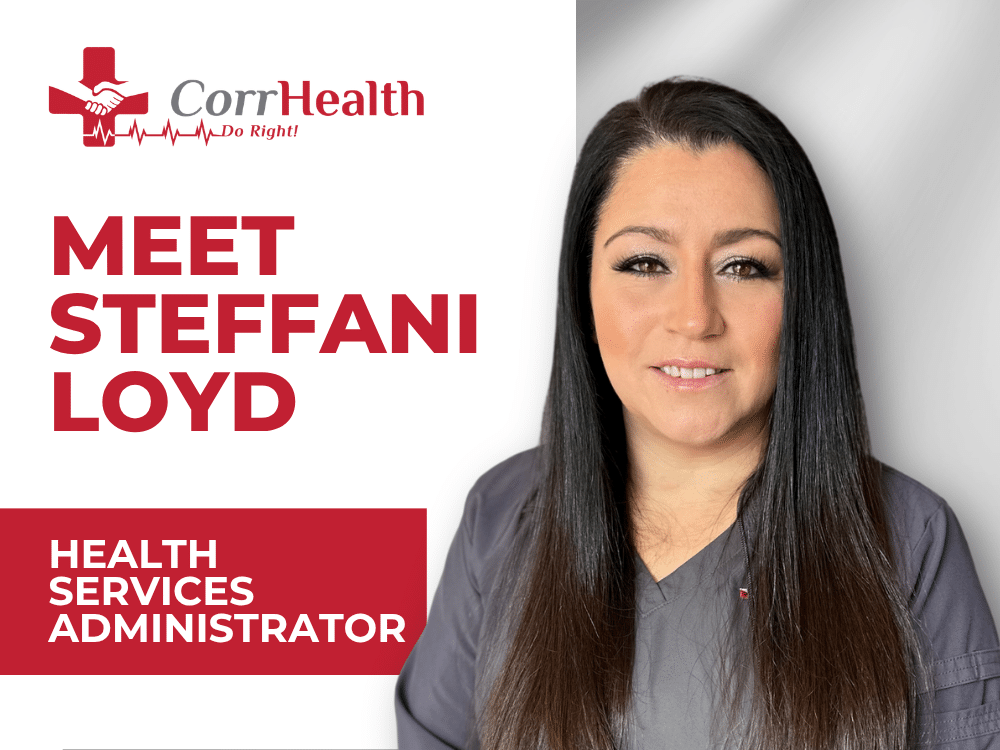
Steffani’s journey to nursing was anything but traditional, and that may be exactly what makes her and her story so inspiring.
Before becoming an RN, Steffani worked in corrections in Nevada and spent 10 years in casino surveillance, eventually becoming a surveillance supervisor. Nursing wasn’t something she had envisioned for herself. In fact, she didn’t earn her GED until she was in her early 30’s. It was her sister, an RN herself, who first encouraged Steffani to consider nursing.
But when the opportunity to pursue nursing became possible, Steffani went all in.
She began college while working full-time and raising a family, completing her prerequisites before entering the nursing program at Vernon College in Wichita Falls. Then COVID arrived right in the middle of nursing school.
There were plenty of reasons she could have stopped. She didn’t.
“I had someone tell me, ‘I don’t know how you think you’re going to be able to do this,’” Steffani recalls. “I kept that in the back of my mind. That became my drive because I thought, ‘There is no way I’m going to fail.’”
Finding Her Place in Correctional Healthcare
After graduating, Steffani began her nursing career in Med-Surg at United Regional to build a strong clinical foundation. Later, while looking for a PRN opportunity, she found CorrHealth. She planned to simply see what correctional nursing was like. Two weeks later, she was offered a full-time role.
Steffani readily admits correctional nursing came with a learning curve, but she quickly discovered how meaningful the work could be. “We’re providing care to an underserved portion of the community,” she says. “The difference we can make with one patient can sometimes make a difference in their life.”
She experienced that firsthand while working as a charge nurse when she responded to an overdose. Her team administered Narcan, provided oxygen, and transferred the patient to the hospital. Much later, a man approached her in Walmart. She didn’t recognize him, but he recognized her.
“He came up and gave me the biggest hug,” Steffani remembers. “He introduced me to his girlfriend and his new baby and said, ‘You saved my life.’ He told me it had been a wake-up call and that he had gotten clean.” “That’s when it really drove home for me. We really do make a difference.”
Building a Team Through Support and Accountability
Today, Steffani is just as passionate about developing her team as she is about patient care. Her leadership philosophy is straightforward: supportive, training, and giving her team what they need to be successful.
“I supported them, but I also held them accountable,” she says. “My expectations are clear. We take care of our patients, we do our jobs, and we follow our policies and procedures. I work for my team, not the other way around.”
She is especially proud of watching her staff become a connected team that supports one another while getting the work done. She has also strengthened relationships between medical staff and county officers.
“You should see the officers come in now. They sit down and talk with the nursing staff. The relationships we have built with the county are something I’m incredibly proud of.”
Steffani has introduced operational improvements ranging from redistributing parts of the H&P workload and reducing items that could become contraband to strengthening charting, training, and team development.
But some of her most meaningful efforts are much simpler. Her team votes for an Employee of the Month, she holds drawings for those that attend staff meetings, and she intentionally recognizes both day and night shifts equally.
Having worked nights herself, Steffani knows how easily those team members can feel overlooked. “I’ll change my schedule and stay over so I can buy them lunch and spend time with them,” she says. “I want them to know they are supported too.”
Creating a Culture Where People Can Grow
That word “supported” is central to how Steffani views culture. “Culture is how you feel about the people around you,” she says. “It’s a community. It’s about people working together toward one common goal.”
She brings the same philosophy to developing future leaders, encouraging her team members to think beyond the position they hold today.
“I don’t want them to limit themselves to where they are today. I want to encourage growth in them too.”
Steffani wants her site to set the standard for correctional healthcare, with expanded services such as on-site dialysis and additional specialty training. “I want people to walk into this facility and say, ‘Wow. Look at this medical team.’”
Her vision extends beyond her own facility. “I want CorrHealth to have a footprint nationwide. I want people to hear the CorrHealth name and know we are elite, that we provide the best care.”
Steffani also plans to continue her education, earn her CCHP certification, and grow wherever the organization needs her. Her philosophy is simple: “You lead, and I’ll follow.”
The Experiences That Shaped Her
Away from work, Steffani’s world revolves around her family. She is a mother of four, Dusty, Justin, Aurora, and Riley, and also helps care for her disabled mother. One of her greatest sources of pride is seeing how close her children have become. That is particularly meaningful because Steffani was determined to give her children a different childhood from her own.
Her family struggled financially, and she was pulled out of school at the age of 14, during her freshman year, to help care for younger siblings and relatives. At one point, while still very young herself, she was caring for eight children.
“There were a lot of things in my life that could have been very traumatic,” she says. “I’ve learned to overcome them. I wanted to break that cycle with my children, and my children are thriving.” That determination shows up throughout her life.

Steffani once trained horses, competed in barrel racing, and worked with rope horses. She was also the first female range master with the Nevada Department of Corrections in Nevada and is confident she could outshoot most of the men she worked alongside.
At 18, she testified in a murder trial that resulted in two convictions. During her corrections career in Nevada, she even crossed paths with O.J. Simpson. Her most memorable interaction with him? A disagreement over the size of a piece of cake.
Steffani simply told him, “That’s the luck of the draw. Please continue on.”
And long before becoming a nurse, Steffani had already helped save a life when she was still very young. Her nephew was attacked by a wolf in Oregon. Steffani was there as her mother fought the animal off him. Her nephew suffered a collapsed lung, severe internal bleeding, and dozens of puncture wounds. Steffani called 911 and while her stepdad applied pressure to his wounds until help arrived. He survived, and his story was featured on When Animals Attack, which aired on the Fox network in the mid-to-late 1990s.
When it came up during her interview that she had helped save at least two lives, Steffani hadn’t even thought about it that way.
Helping Others Is Simply What She Does
That response may say more about her than anything else. For Steffani, helping people isn’t something extraordinary. It’s simply what she does.
There is one thing Steffani rarely starts her day without. Coffee. “Every day,” she laughs. “I’ve got to have my coffee.”

And when asked what she hopes her team members would say about her, she doesn’t choose her title, accomplishments, or work ethic. She chooses one word: Supportive. “I want them to feel supported. That’s what matters to me.”
For someone whose life has been shaped by resilience, service, family, and an unwavering desire to keep growing, it feels like the perfect description.