
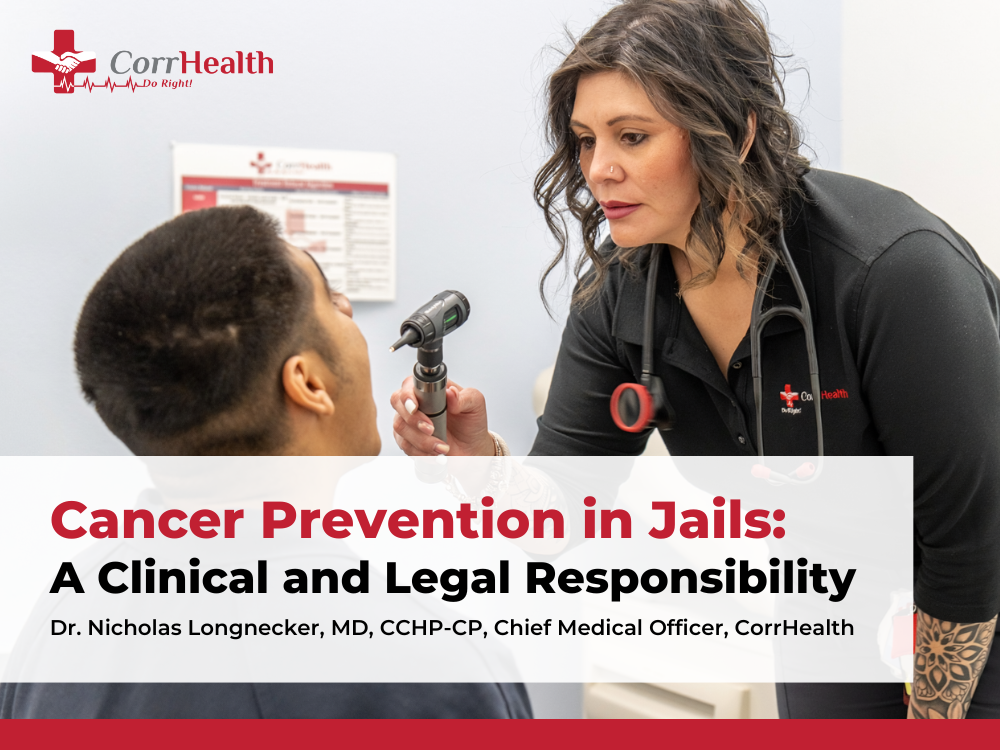
February is National Cancer Prevention Month. In most healthcare settings, this observance prompts conversations about screening, smoking cessation, vaccination, and preventive counseling. Those discussions typically center on primary care clinics and outpatient medicine.
Jails are rarely included. From a correctional healthcare perspective, that omission deserves reconsideration.
For many individuals, incarceration represents the first time in years they have had consistent access to medical care. Intake assessments, chronic care visits, laboratory testing, and medication continuity create regular clinical touchpoints that may not otherwise exist. Within those encounters, cancer prevention in jails is not theoretical. It is a practical and necessary component of responsible medical care.
Access Creates Opportunity
Correctional clinicians often see the same pattern among individuals entering custody: high rates of tobacco use, fragmented or absent preventive care, and overdue screening exams. Chronic viral infections, including hepatitis C and HIV, occur more frequently than in the general population, and health education has typically been limited to brief or episodic encounters rather than consistent, ongoing care.
These realities are not reflections of patient motivation. They are reflections of access.
Once individuals enter a jail, many suddenly have consistent contact with medical professionals and a degree of healthcare continuity that has been missing. That creates a defined, though often limited, window for intervention. Cancer prevention fits squarely within that window.
Clinical Standards and Legal Expectations
Correctional healthcare operates at the intersection of medical standards and legal responsibility. Clinically, care must align with accepted standards of practice. Legally, correctional systems are required to provide constitutionally adequate medical care.
Organizations such as the National Commission on Correctional Health Care (NCCHC) emphasize timely access to care, appropriate preventive services, patient education, and continuity planning. While jails are not expected to deliver comprehensive oncology services, they are expected to identify medical risk, address modifiable factors when reasonable, and respond appropriately to concerning clinical findings.
Cancer prevention in jails aligns with both professional standards of care and sound risk-management principles. Failure to recognize or address clear risk factors, warning signs, or preventive needs can create avoidable clinical and legal exposure.
Tobacco Use: A High-Impact Intervention
Tobacco use remains the leading preventable cause of cancer. Correctional populations experience disproportionately high rates of nicotine dependence, increasing long-term risk for lung, head and neck, bladder, and gastrointestinal cancers. Most jails operate as smoke-free environments. That policy alone creates a meaningful opportunity.
Routine tobacco-use screening, brief counseling, and appropriate use of nicotine replacement therapy are clinically sound, low-cost interventions. They require no specialized infrastructure and align with community standards of care. From both a clinical and legal standpoint, addressing tobacco use is a reasonable and defensible component of cancer prevention in the jail setting.
Vaccination and Infectious Disease Management
Vaccination is sometimes overlooked in discussions of cancer prevention, yet its role is clear. Hepatitis B vaccination reduces the risk of hepatocellular carcinoma, and HPV vaccination reduces the risk of cervical and several other cancers.
Many incarcerated individuals have incomplete vaccination histories due to gaps in access rather than refusal. Offering or continuing vaccines during incarceration is medically appropriate, consistent with national guidance, and supportive of public health. From a liability perspective, providing indicated vaccinations when feasible reinforces care consistent with community standards.
Similarly, the association between chronic infection and cancer is well established. Hepatitis C and HIV, which are more prevalent in correctional populations, are linked to increased malignancy risk over time. Testing, treatment initiation, and linkage to care are already core elements of correctional medicine. These interventions address current disease while simultaneously reducing future cancer risk.
Awareness, Early Identification, and Education
Jails are not designed to function as longitudinal screening centers, and expectations must remain realistic. However, correctional clinicians routinely encounter patients who are overdue for screening or who report symptoms that warrant further evaluation.
Identifying risk, recognizing red flags, documenting findings, and planning for follow-up can meaningfully alter long-term outcomes. In many cases, cancer prevention in jails is less about completing every screening test during custody and more about awareness, documentation, and continuity.
Patient education also plays an essential role. Health education in jails may be brief and informal, yet it can be clinically meaningful. Conversations during intake, chronic care visits, or laboratory review may be the first time patients receive clear explanations about cancer risk factors or warning signs.
Education does not need to be elaborate to be effective. Providing accurate and understandable information supports informed decision-making and aligns with correctional healthcare standards.
Continuity Beyond Release
Most individuals in jail return to the community within a relatively short period of time. Preventive care delivered during incarceration does not remain confined to the facility.
Vaccinations initiated, tobacco cessation addressed, infections treated, and referrals identified all contribute to improved post-release health outcomes. From this perspective, correctional healthcare functions as an extension of the broader healthcare system. Cancer prevention efforts during incarceration benefit not only individual patients but also the communities to which they return.
Leadership Perspective
“Correctional healthcare sits at the intersection of clinical responsibility and legal obligation. Addressing cancer risk in the jail setting through tobacco cessation, vaccination, infectious disease management, and patient education is consistent with accepted standards of care and supports both patient outcomes and system accountability.”
— Nicholas Longnecker, MD, CCHP-CP, Chief Medical Officer
A Measured but Meaningful Responsibility
Cancer prevention in jails is not comprehensive, and it is not perfect. It is often incremental and constrained by the inmates’ length of stay and operational realities.
Nonetheless, it represents real care delivered in real clinical encounters. During National Cancer Prevention Month, it is appropriate to acknowledge that correctional healthcare plays a meaningful role in cancer prevention, clinically, ethically, and legally.
Providing nothing is not a neutral position. Providing reasonable, standards-based preventive care is.